

The Metaphysical Noon
Salvo, and the strange colour of a world emptied of people.

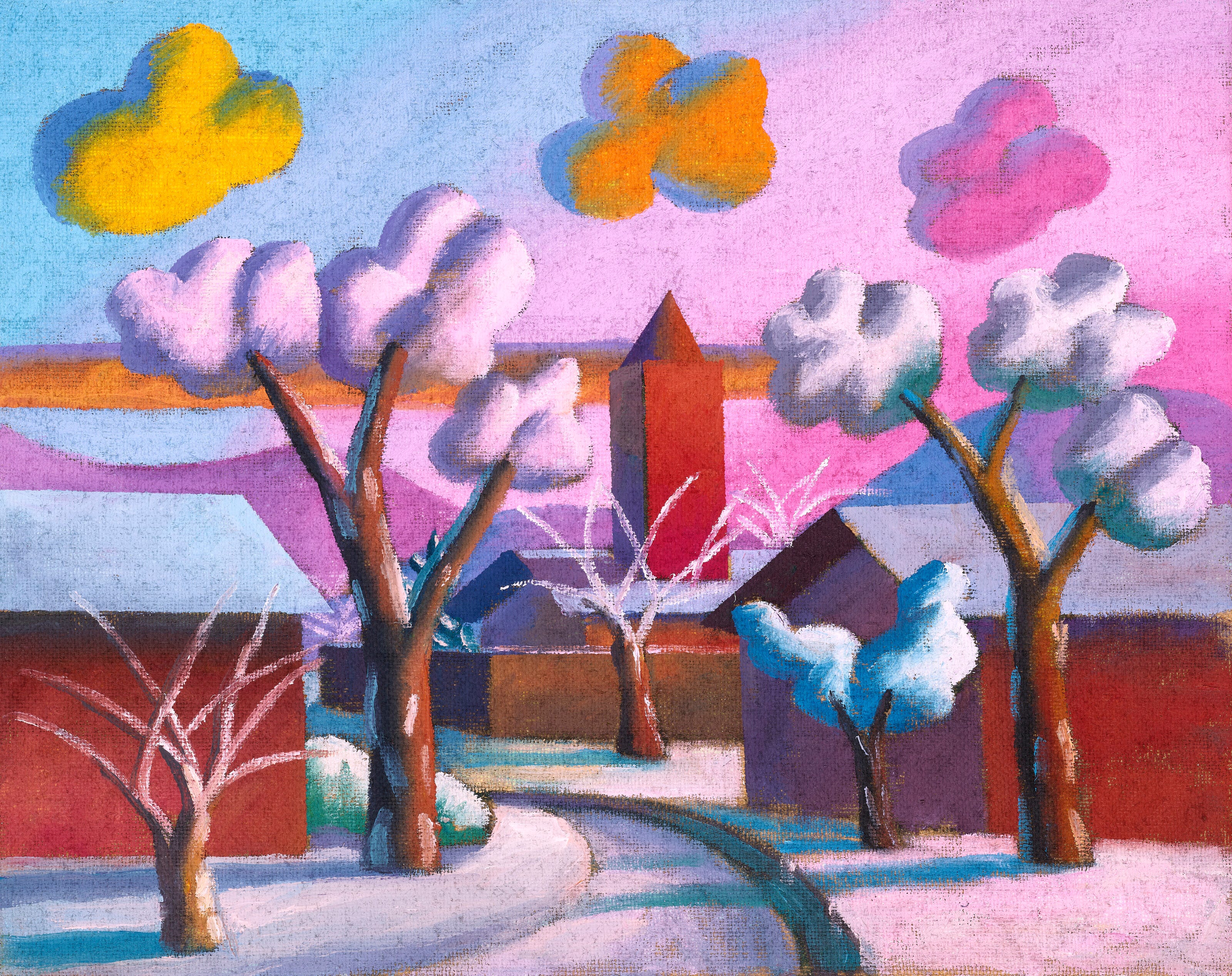
I have stood in a small Italian town at the blue end of the day and watched the snow blush into a colour that snow, by all rights, should never attempt. It was an hour of no particular ambition, a winter afternoon quietly surrendering to evening, the sort of hour you pass through en route to somewhere with central heating. Then the light, as if bored with its own routine, performed a trick I have never managed to describe. The snow turned violet. The wall behind it was the pink of a sweet you are now far too old to buy, and above the roofline the sky held a green so implausible I could not name it without feeling I was making things up.
It took me a moment to notice what was absent, precisely because nothing was. The walls stood, the windows blinked, the snow lay solid and luminous; the whole town looked as if it had just been unwrapped. Everything was present except us. I stood, my breath manufacturing its own tiny climate, and waited for the scene to right itself. No car arrived. No shutter stirred. The town was not abandoned; it had simply been left to its own devices.
I have seen that exact light since, indoors, pinned to a wall. It answers now to a painter’s name.
The Man Who Left Himself Out
The light belongs to Salvo, born Salvatore Mangione in Leonforte, in the Sicilian interior, in 1947. His family moved to Turin in 1956, and Turin, not Sicily, became the country of his painting. He began as a conceptual artist with a single obsessive subject: himself. In the Turin of Arte Povera, he shared a studio with Alighiero Boetti until 1971, and his early works are monuments to his own name: marble plaques, a tombstone cut for himself whilst he was still alive, the word SALVO set in stone (he even slipped his own face into the poses of the old masters, Self Portrait as Raphael, 1970). For a while he was the entire content of his own art. Then he did something his friends read as a betrayal.
In 1973 he left concept behind and picked up a brush, painting himself as Saint Martin. That work now hangs in Turin’s GAM.
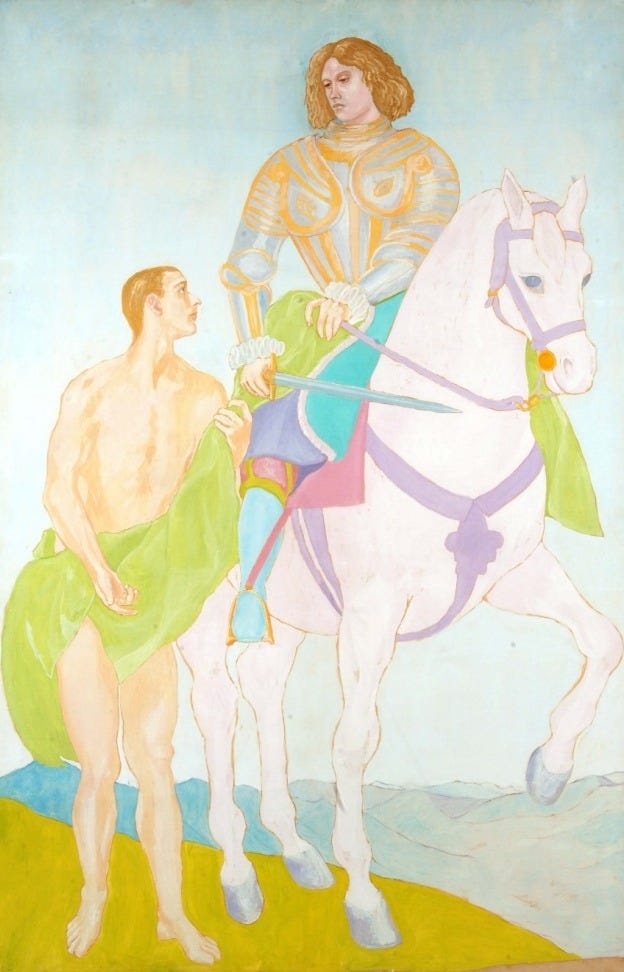
In the sanctum of conceptual art, painting a saint on horseback was outright heresy. He did it with intent. Then he erased even himself: from the late 1970s until his death in 2015, he painted almost nothing but places, and almost never a soul within them. The colour arrived at full volume: violet clouds, greens turned up to eleven, a moon as flat and gold as a coin, a palette that glowed, as someone at Christie’s once put it, "like a giant jukebox". He is the boisterous twin of Giorgio Morandi, who emptied the world in the opposite direction, muting his bottles to dust and hush; both men painted rooms and towns with the people quietly subtracted. And here is the strangest fact: Salvo painted by electric light, never by daylight, so the colour is not a weather report but a deliberate invention.
The Church at an Impossible Hour
The church is real, and it recurs: San Giovanni degli Eremiti in Palermo, crowned with its cluster of red Arab-Norman domes, a building Salvo painted obsessively. Each version offers the town at night, glimpsed from just outside, as if you had decided not to enter. The sky is never black. It is a green that leans into petrol blue, and it refuses to darken at the edges as a real sky would; it simply holds, flat and unwavering, like a freshly painted wall. When he sets the church in snow, the snow turns violet and the domes are the precise red of a toy. Nothing in these pictures is the colour the eye would confess to seeing, and nothing in them bothers to apologise.
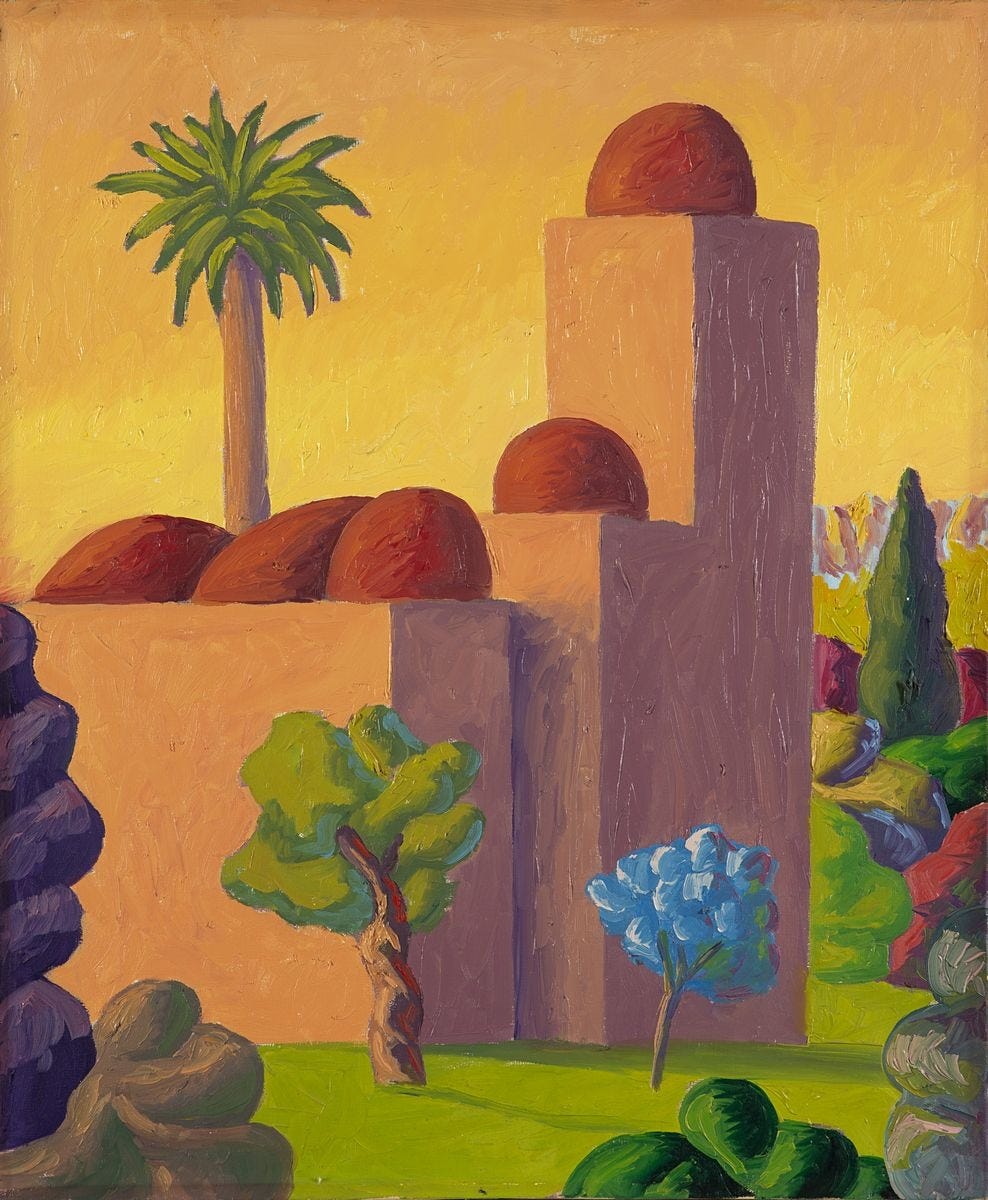
There is always a door, and it is always closed. There is always a road in, and it is always empty. In one version, the road simply halts at the first houses, as if reconsidering the whole business of arrival. This is not a quirk but a law: across his work, the human figure has vanished, into what one Christie’s writer called "an aching temporal stillness". Each nocturne is a stage awash in coloured light long after the cast has gone home. No one enters. The colour must carry the scene alone.
In an ordinary painting, a person tells you what to feel. Here there is no person, so the violet tells you, and the toy-red, and the flat gold moon. The colour is not decoration laid over the world; it is the feeling the missing people took with them, set down on the snow so it would not be lost. And remember how he worked: under electric bulbs he was never copying an evening, he was building one. This is why the colour reads as holy and not merely pretty. It is the gold-ground light of an icon, a light that belongs to the sacred picture and not to any real sky.
Stand before one long enough, and the emptiness ceases to feel like absence. It begins to feel like the very reason the colour is permitted to sing so loudly.
A Mind of Winter
There is a poem that describes Salvo’s viewer before Salvo ever painted him: Wallace Stevens, “The Snow Man,” written in 1921. It is one sentence, fifteen lines, and it is about what you must become to look at a winter field without lying about it. It begins with a rule.
One must have a mind of winter
To regard the frost and the boughs
Of the pine-trees crusted with snow.
Wallace Stevens, “The Snow Man” (1921).
Stevens’ demand is precise. You must not imagine any misery in the sound of the wind; you must resist the urge to spill yourself into the landscape, to wrap the cold in your own small sorrows. Salvo asks the same discipline of us, but from the other side of the frame. He has already emptied the field; the work is done for us, executed in paint before we arrive. There is no one left to channel our feelings through: no shepherd, no glowing window, no figure at the road’s end to shoulder our sadness. Stevens instructs you to become a mind of winter. Salvo simply paints the world as a mind of winter would see it.
The poem closes on a listener “nothing himself,” who beholds “Nothing that is not there and the nothing that is.” The person is still technically in the poem, worn down to a pair of eyes in the cold. In Salvo even the eyes are gone, and only the seen remains, bright and finished and unwitnessed, the way the world must look in the second before we walk into a room.
Salvo did not paint the world without us. He painted the world at peace, which, in the end, proved to be the same thing.
The Great Noon
Nietzsche had a name for the hour when the sun stands straight overhead, and a thing throws almost no shadow: the great noon, der grosse Mittag. He ends one of his most famous pages on it, exactly: “Noon; moment of the shortest shadow … INCIPIT ZARATHUSTRA.” Read it slowly. The shortest shadow is the moment a thing is most purely itself, with almost nothing of it falling away into the dark. Noon is not the death of the world; it is the world at its clearest, and its most alone. Hold that against the violet snow. In Zarathustra the noon is a stopped, perfected hour: lying under a vine, Zarathustra asks whether the world has “just now become perfect.”
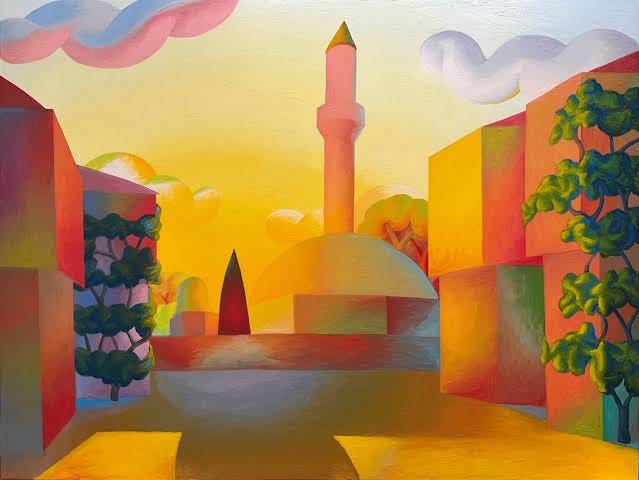
A painter arrived first. Giorgio de Chirico constructed metaphysical painting from a single Nietzschean mood, and "he named it himself": "the melancholy of lovely autumn afternoons in Italian cities". His empty piazzas, the elongated shadows, the closed arcades with no one home: that arrested hour made visible, circa 1910. Salvo is the late heir to that afternoon, with the melancholy siphoned away and the colour dialled to maximum. The same empty square, a different climate of the soul.
And here is a coincidence that is not quite accidental: Turin. Nietzsche spent his last lucid autumn there in 1888, extolling in his letters the city’s arcades, its autumn colours, its remarkable clarity, and he unravelled there that January. Turin is also where Salvo lived and painted for nearly sixty years. One city, three men, one hour. Nietzsche named the noon, de Chirico painted its shadow, and Salvo, under the same northern light, painted the noon itself: the world clear, complete, and emptied of us.
The Missing Figure Is You
Something in the market has caught on. Salvo was modest in his lifetime; after his death, his prices soared, and in 2023 his auction turnover leapt by more than six hundred per cent. His record is a painting called Il Mattino, The Morning, sold in Hong Kong in 2023 for about a million dollars, more than triple its estimate.
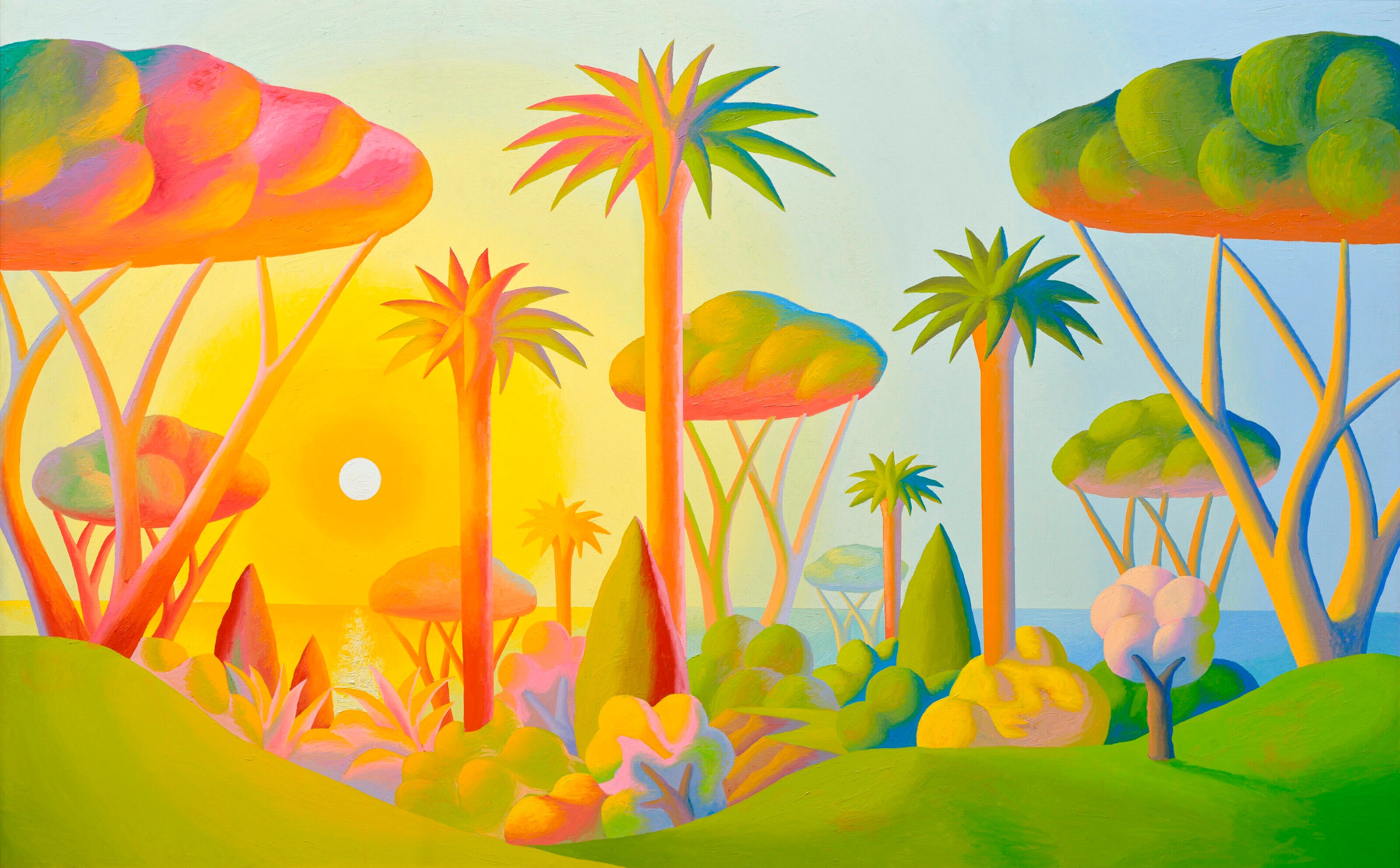
A Christie’s specialist put it plainly: collectors in Asia, drawn to those silent scenes and that intensity of colour". The trade calls it taste: eyes trained on the saturated hues of manga and the screen, untroubled by a green sky. Perhaps. But look at what is selling. In an age awash with human faces, especially our own, the pictures most coveted are the ones with no one in them. We have never been more photographed, or less alone. Salvo offers the one thing the feed cannot: a place, in full colour, with the people quietly removed.
Somewhere this evening, in a small town neither of us could name, the day is slipping into its blue conclusion: the snow turning violet, a wall holding fast to its impossible pink, the street not missing us in the slightest. Go and look. The town will be just as bright, just as empty, and for a moment you will not mind being the only one there.
it’s art is free: one essay every few weeks, when something is worth saying.
Know someone who’d sit with this? Send it their way.
Esta lectura me dejó en un silencio profundo. Terminé respirando más despacio y recordando que, a veces, también necesitamos textos que nos devuelvan a la paz. Gracias, Vi.
so beautifully written, and interesting too. You could make a book of these essays!